Winding deformation is a hidden danger of safe operation of power transformers. The actual experience of multiple transformers shows that after the winding deformation, the insulation test and the oil test are difficult to find, so it is a latent fault.
Power transformers are inevitably subjected to various fault short-circuit currents or physical impacts during operation or transportation. Under the strong electric power generated by short-circuit current, the transformer windings may lose stability, resulting in local distortion, bulging or shifting. The permanent deformation phenomenon, etc., so the winding of the transformer needs to be measured to ensure the safe use of the transformer.
When the transformer experiences inter-turn and phase-to-phase short circuit during the test, short circuit or other fault occurs during operation. The coil is displaced due to electromagnetic tension. The relative displacement of the coil is caused by the collision during transport. These factors will change the transformer distribution parameters. The frequency domain response also changes, and the deformation degree of the transformer can be judged according to the frequency domain response curve.
Other Related Articles:
The Most Complete Transformer Vector Group Collection with Winding Connection Diagrams
How Important is Transformer DC Winding Resistance?
Top 6 transformer winding resistance testers Worldwide (Including Prices)
How should Winding Resistance be Tested Differently on CT and PT?
What is the Difference between DC Resistance and Insulation Resistance and How to Test Them?
8 Tips to Improve the Accuracy of DC Resistance Measurement
Why is the Tested Winding Resistance Always Inaccurate? You May Have Overlooked These 6 Key Points
Kingrun Transformer Instrument Co.,Ltd.

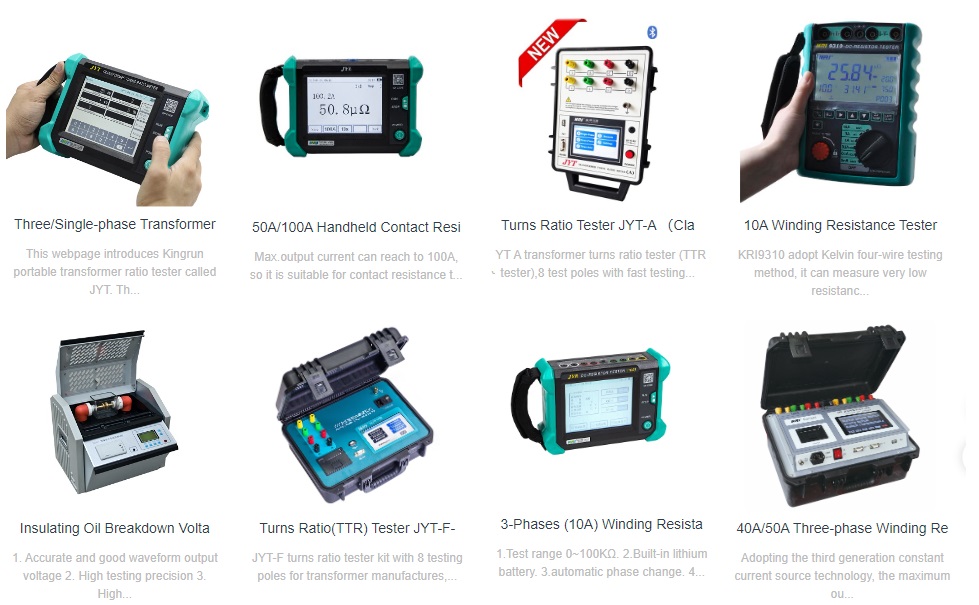
More Transformer Testers from Kingrun