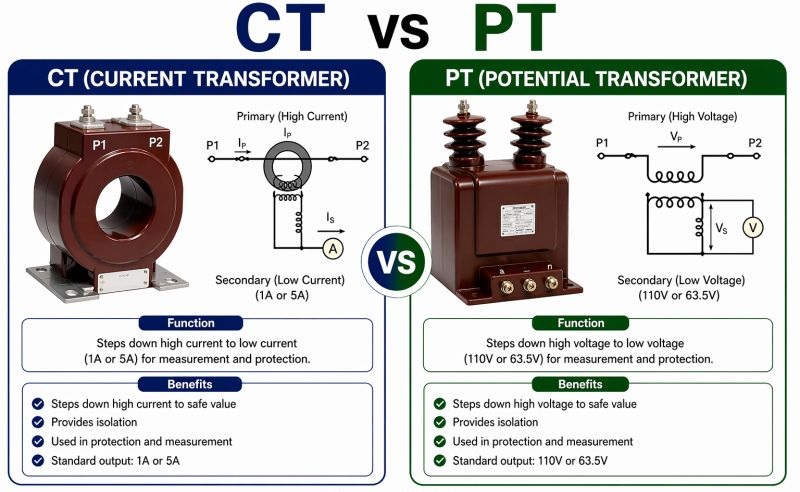
Trong các hệ thống điện, CT (Current Transformer) và PT (Potential Transformer) là các thiết bị cần thiết được sử dụng để đo lường và bảo vệ an toàn.
⚡ CT (Current Transformer) là gì??
CT làm giảm dòng điện cao xuống còn giá trị an toàn hơn (thường là 1A hoặc 5A) để có thể đo bằng các dụng cụ. Nó luôn được kết nối theo chuỗi với đường dây.
✅ Lợi ích của CT:
Đảm bảo đo dòng điện an toàn
Cung cấp sự cô lập từ các đường dây hiện tại cao
Cải thiện độ chính xác hệ thống bảo vệ
Thường được sử dụng với ammeters và rơ le bảo vệ
Nơi CT được sử dụng:
Trạm điện, trạm phụ, tấm công nghiệp và hệ thống đo năng lượng.
Lưu ý an toàn quan trọng: Mặt thứ cấp của CT không bao giờ được mở mạch trong khi mặt chính được năng lượng.
⚡ PT (Máy biến áp tiềm năng) là gì?
Một PT làm giảm điện áp cao xuống giá trị tiêu chuẩn thấp hơn (như 110V hoặc 63,5V) để đo và bảo vệ. Nó luôn được kết nối song song với đường.
✅ Lợi ích của PT:
Đảm bảo đo điện áp an toàn
Cung cấp cách ly từ các đường dây điện áp cao
Giúp giám sát và kiểm soát chính xác
Được sử dụng với điện áp và relé
Nơi PT được sử dụng:
Dây chuyền truyền tải, trạm phụ, nhà máy chuyển mạch và hệ thống giám sát.
⚠️ Lưu ý an toàn quan trọng: Phía thứ cấp của PT không bao giờ được ngắn mạch.
| Tính năng | Máy biến áp hiện tại (CT) | Máy biến áp tiềm năng (PT) |
| Kết nối chính | Kết nối Dòng | Kết nối song song |
| Chức năng | Bước xuống hiện tại | Bước xuống điện áp |
| Giá trị thứ cấp | Thông thường là 1A hoặc 5A | Thông thường 110V hoặc 100V |
| Nhà nước làm việc | Gần ngắn mạch | Gần mạch mở |
| Khu vực nguy hiểm | mạch mở gây ra điện áp cao | Ngắn mạch Nguyên nhân hiện tại cao |