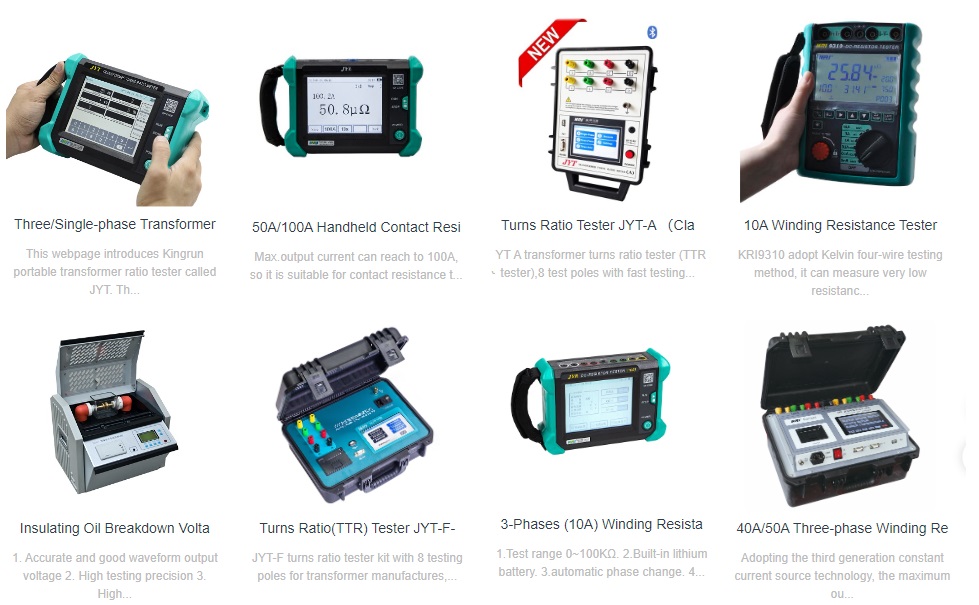
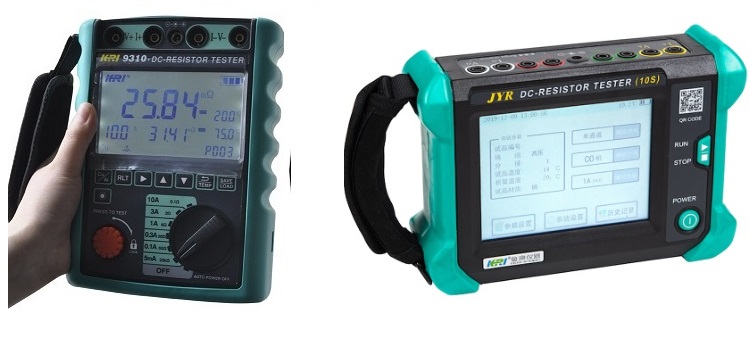
In the field of power system maintenance, accurate and reliable measurement of winding resistance is essential for ensuring the performance and longevity of transformers, relays, and other inductive devices. Traditional winding resistance testers are often bulky and cumbersome, making on-site testing challenging. Handheld winding resistance testers, such as Kingrun’s JYR-10S and KRI9310, address these limitations by combining portability, precision, and user-friendly operation, offering a practical solution for field technicians and engineers.
Electrical workers often face the challenge of measuring the winding resistance of power transformers, distribution transformers, and other inductive devices. Traditional winding resistance testers are typically large, heavy, and difficult to transport, making field measurements cumbersome. To address this limitation, handheld winding resistance testers such as the Kingrun JYR-10S and KRI9310 models have been developed, offering portability, high accuracy, and convenient operation.
One of the key advantages of handheld winding resistance testers is their compact size and lightweight design, which allow technicians to perform tests in situ without the need for bulky equipment. The JYR-10S, for example, is designed with a built-in lithium battery and can simultaneously test all three phases of a transformer. Its automatic phase change function further simplifies the testing process, reducing the chance of human error and increasing efficiency.
Accuracy and versatility are also major benefits. Handheld testers are capable of measuring very low resistance values, making them suitable not only for transformers but also for relay contacts, switch contacts, electromagnetic operating mechanisms, and other inductive test products. The KRI9310, a related model, provides high-precision measurements with reliable repeatability, ensuring that test results are consistent and trustworthy. Both models support a variety of test objects, including wires and coil windings, broadening their application across different electrical systems.
Another advantage is the ease of data handling and portability. Modern handheld winding resistance testers typically include intuitive interfaces, clear digital displays, and sometimes USB or Bluetooth connectivity for data transfer. This allows technicians to store, analyze, and share measurement data quickly, supporting efficient reporting and quality control in the field.
Safety is also improved with handheld testers. By minimizing the need for heavy cables and large external power sources, technicians can perform measurements more safely in constrained spaces, such as substations, switchgear rooms, or transformer installations. Additionally, battery-powered operation eliminates reliance on external AC supply, enhancing usability in remote locations.
Handheld DC resistance testers like the Kingrun JYR-10S and KRI9310 combine portability, precision, versatility, and safety, making them indispensable tools for modern electrical maintenance. They overcome the limitations of traditional testers, enabling reliable, on-site measurements across a variety of power system components. By providing efficient and accurate results, these handheld instruments help ensure the operational performance, safety, and longevity of electrical equipment.
Related Articles:
The Most Complete Transformer Vector Group Collection with Winding Connection Diagrams
How Important is Transformer DC Winding Resistance?
Top 6 Transformer Winding Resistance Testers Worldwide (Including Prices)
How should Winding Resistance be Tested Differently on CT and PT?
What is the Difference between DC Resistance and Insulation Resistance and How to Test Them?
8 Tips to Improve the Accuracy of DC Resistance Measurement
Why is the Tested Winding Resistance Always Inaccurate? You May Have Overlooked These 6 Key Points
Kingrun Transformer Instrument Co.,Ltd.
More Transformer Testers from Kingrun