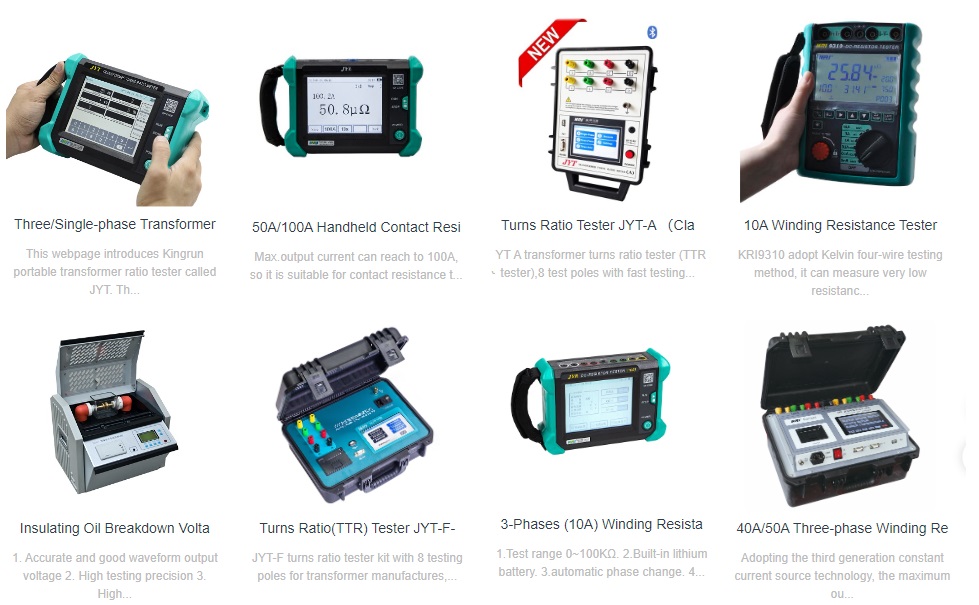
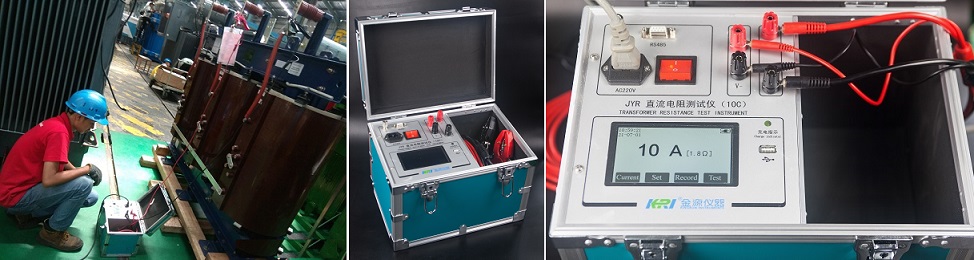
Winding fault of power transformer normally divided two kind, one is during transformer manufacturing or producing, another is breakout accident during transformer working, for example, because of poor insulating of turns and layer, damage during transformer producing, that cause short-circuit between turn and layer; short distance among main insulation so that cause breakdown among winding or winding discharge to ground; winding group was surged by voltage and short-circuit, cause winding distortion, burned out of insulation, winding line break off, because protection equipment didn’t work, JYR transformer winding resistance tester and turn ratio tester will help technician and maintenance work to find problem of transformer out with fast speed.
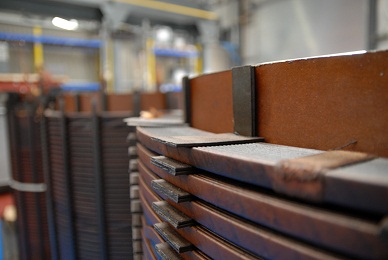
Inter-turn / Inter-layer Insulation Weakness:
Caused by substandard insulation thickness, winding process deviations (such as overlapping turns), or inherent issues of aluminum windings such as lower conductivity and concentrated heating, leading to premature insulation aging and breakdown.
Insufficient Main Insulation Clearance:
Occurs when insulation paperboard or spacer dimensions are undersized in design, or misaligned during assembly, resulting in inadequate clearance between windings or between winding and ground. This causes electric field concentration and partial discharge.
Winding Structural Defects:
Due to poor soldering of conductor joints or uneven winding tension, creating hidden discontinuities or stress concentration points that can cause wire breakage or deformation during operation.
Mechanical Damage from Electrodynamic Forces:
During system short circuits, strong electrodynamic forces can deform windings or displace conductors, leading to inter-turn short circuits.
Overvoltage Impact Damage:
Lightning strikes or switching surges can puncture main or inter-turn insulation, causing discharge to ground or turn-to-turn short circuits.
Overheating and Aging Faults:
Long-term overloading, cooling system failure, or contamination/moisture in insulation materials can cause gradual insulation degradation and carbonization, eventually resulting in winding burnout.
Conductor Break Faults:
Repeated electrodynamic shocks during short circuits, thermal expansion and contraction, or corroded solder joints may lead to conductor breakage.
Localization:
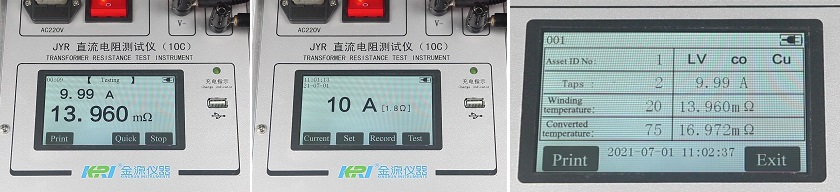
Use the JYR DC resistance tester to detect resistance deviations, combined with a turn ratio tester to identify shorted areas. Perform a local withstand voltage test to pinpoint the exact fault zone.
Repair Methods:
Small transformers (capacity <1000 kVA):
Dismantle the faulty winding section, remove damaged insulation layers, replace them with higher-grade materials (e.g., Nomex paper), rewind, and perform vacuum varnish curing.
Aluminum-to-Copper Conversion:
Replace aluminum conductors with copper conductors of equivalent cross-section to take advantage of copper’s higher conductivity and lower heat generation, allowing for increased insulation clearance and improved reliability.
Note:
After repair, conduct an inter-turn withstand voltage test at 1.5 times rated voltage to ensure no latent short circuits remain.
Localization:
Identify weak insulation areas (such as winding ends or phase-to-phase insulation) using insulation resistance measurement and partial discharge detection.
Repair Methods:
Increase Insulation Strength:
Insert thicker epoxy glass cloth boards between windings, add insulation spacers on the winding-to-ground side, ensuring clearance meets field strength requirements (typically ≥3 mm/kV).
Optimize Insulation Structure:
For large transformers, use a paperboard + spacer bar combination structure to prevent material displacement and improve heat dissipation.
Verification:
Perform an overall withstand voltage test at 2 times rated voltage for 1 minute with no discharge phenomena.
Localization:
Use a winding deformation tester (frequency response analysis method) to compare amplitude–frequency response curves against standard references, assessing deformation level (slight, moderate, severe).
Repair Methods:
Slight deformation (displacement <5 mm):
Realign winding position on-site, reinforce spacers and press rings, restore conductor arrangement, and rebind securely.
Moderate deformation:
Dismantle the winding completely, replace deformed conductors, rewind with mechanical fixtures ensuring circularity, and perform vacuum varnish impregnation.
Severe deformation (large transformers):
Return to factory for rewinding using professional winding machinery and non-destructive testing (e.g., X-ray inspection) to ensure compliance with design standards.
Localization:
Use the DC resistance tester to detect infinite or abnormally high resistance, combined with infrared thermography to locate burnt or broken sections.
Repair Methods:
Small transformers:
Dismantle the yoke section of the core, remove the damaged winding, replace with identical conductor specifications, rewind per original process, and test resistance, withstand voltage, and turn ratio.
Large transformers (capacity ≥10,000 kVA):
Must be factory repaired with sectional winding and overall vacuum drying processes to ensure insulation uniformity and mechanical strength. Conduct temperature rise tests to verify heat dissipation.
Special Handling:
If burning is severe, inspect the core for localized overheating or carbonization. Replace silicon steel laminations if necessary.
Regular Testing:
Perform DC resistance and turn ratio tests every 6 months, insulation resistance and partial discharge tests annually, and add winding deformation tests after short-circuit faults.
Operational Control:
Avoid transformer overloading; ensure effective cooling (e.g., forced oil circulation), regularly clean dust and oil from winding surfaces to prevent moisture absorption.
Overvoltage Protection:
Install surge arresters and surge absorbers on the transformer input side to mitigate lightning and switching surge impacts.
Material Upgrades:
For new units or major overhauls, prioritize copper windings and insulation materials rated above 155°C, enhancing anti-aging and overload endurance.
Other Related Articles:
The Most Complete Transformer Vector Group Collection with Winding Connection Diagrams
How Important is Transformer DC Winding Resistance?
Top 6 transformer winding resistance testers Worldwide (Including Prices)
How should Winding Resistance be Tested Differently on CT and PT?
What is the Difference between DC Resistance and Insulation Resistance and How to Test Them?
8 Tips to Improve the Accuracy of DC Resistance Measurement
Why is the Tested Winding Resistance Always Inaccurate? You May Have Overlooked These 6 Key Points
Kingrun Transformer Instrument Co.,Ltd.
More Transformer Testers from Kingrun