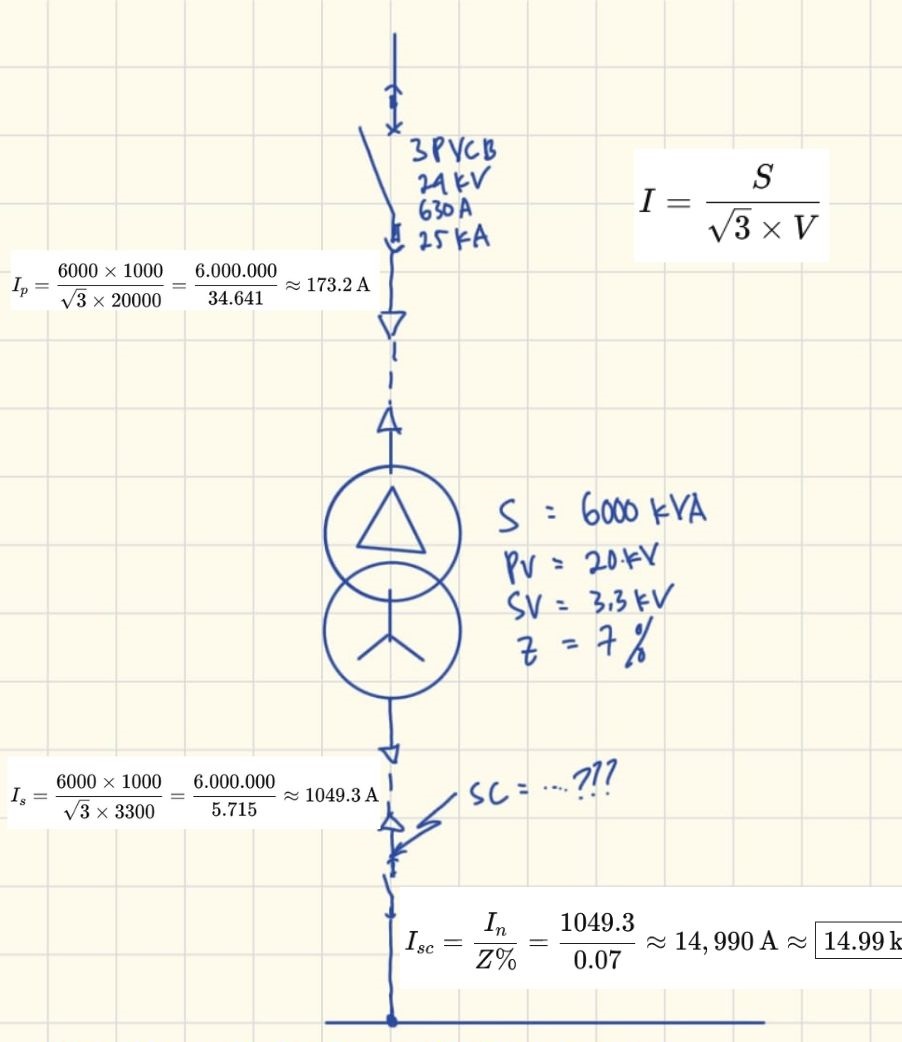
In an industrial distribution substation, there is a large transformer with a capacity of 6000 kVA. It has long been instrumental in reducing the voltage from the 20,000-volt (20 kV) network to 3,300 volts (3.3 kV) for safety and compatibility with the equipment/machinery used.
However, in the world of electricity, the threat of a short circuit can arise at any time, whether from damaged cables, equipment failure, or improper connections. When this occurs, the current can surge significantly. If the system is not prepared, the impact can damage equipment, burn cables, or even start a fire.
Transformers have a natural protective property called internal impedance, with an impedance value of 7%. This means that if all the power (6000 kVA) were flowing under a fault, the voltage would drop by 7%.
"If a short circuit occurs on the 3.3 kV side, how much current will flow?"
If the transformer nameplate indicates:
- Transformer capacity (S) = 6000 kVA
- Primary voltage (Vp) = 20,000 V (20 kV)
- Secondary voltage (Vₛ) = 3,300 V
- Impedance (%Z) = 7%
First, calculate the nominal current (In) on the primary and secondary sides.
a. Primary current (Ip): 173.2 A
b. Secondary current (Is): 1049.3 A
Next, calculate the short-circuit current.
Isc = In / Z%
So, the secondary short-circuit current (Iₛc): 14.99 kA
"Thanks to precise calculations, we can install circuit breakers and protective relays with the appropriate ratings. The transformer remains safe, ready to serve the load, and ready to handle any disturbances that may occur."
Note: The calculation formula can be seen in the image below.
Kingrun Transformer Instrument Co.,Ltd.



More Transformer Testers from Kingrun