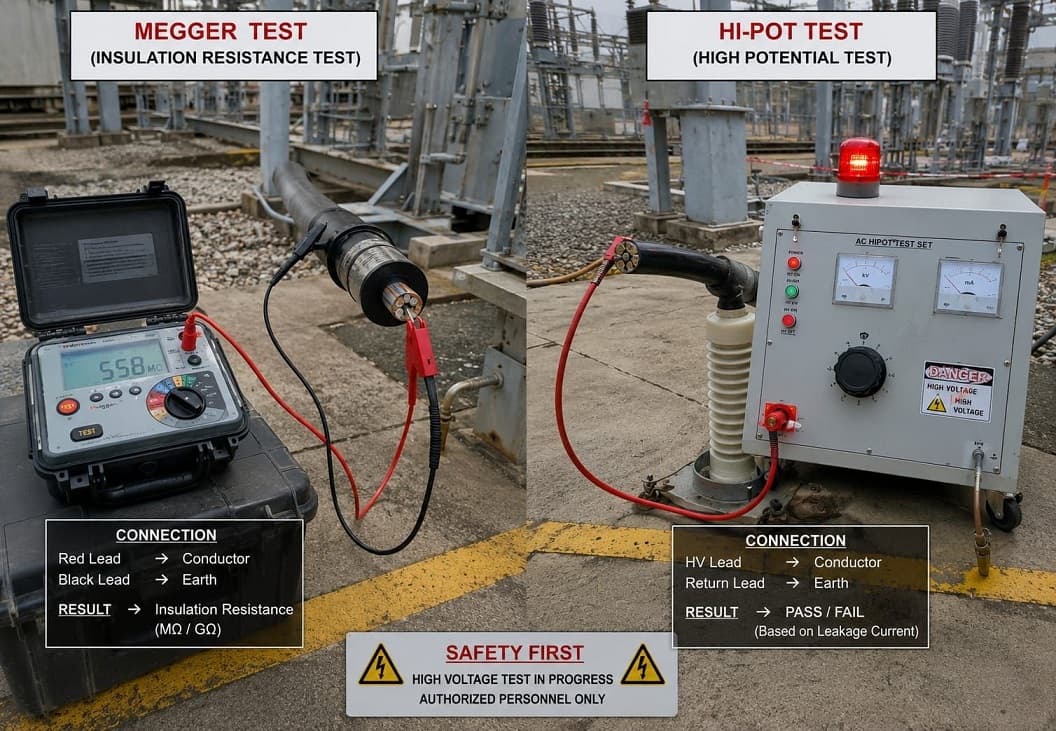
In electrical Quality Assurance/Quality Control (QA/QC), commissioning, and substation engineering, both tests are critical, but they serve completely different purposes.
"The Health Check-up Before Power-On"
Core Purpose: Measures the quantitative resistance value of the insulation system using DC voltage to evaluate the degree of moisture, contamination, or aging.
Test Results: Provides specific resistance values in Megohms (MΩ) or Gigohms (GΩ). It can also calculate the Polarization Index (PI) and Dielectric Absorption Ratio (DAR).
Nature: Non-destructive test.
Applications: Routine maintenance and pre-commissioning checks for transformers, motors, switchgear, and MV/LV cables.
"The Stress Test for Extreme Limits"
Core Purpose: Applies AC or DC voltage far higher than the rated operating voltage to verify the dielectric strength of the insulation, ensuring it will not breakdown under operating overvoltages or lightning surges.
Test Results: Qualitative results (Pass / Fail), while monitoring the leakage current.
Nature: Destructive / Over-stress test (if the insulation has severe defects, it will intentionally be breached/punctured).
Applications: Acceptance testing and commissioning activities for MV/HV cables, Gas Insulated Switchgear (GIS), circuit breakers, and major substation equipment.
| Feature | Megger Test (IR) | Hi-Pot Test |
| Primary Purpose | Checks insulation condition and moisture | Verifies insulation dielectric strength |
| Output Voltage | Lower DC voltage (typically 500V - 5000V) | Extremely high AC or DC voltage (tens of kV) |
| Test Results | Specific resistance values (MΩ/GΩ) | Pass / Fail |
| Nature of Test | Non-destructive; used for maintenance/diagnostics | Potentially destructive; used for commissioning |
| Sequence of Test | Must be performed first | Only after passing the IR test |
Scenario: A newly installed 10kV XLPE (Cross-Linked Polyethylene) power cable must undergo site QA/QC testing before being energized for commercial operation.
Actual Operation: Technicians use a 2500V digital megohmmeter, connecting one lead to the cable core conductor and the other to the copper screen/earth.
Purpose: To verify that the cable jacket wasn’t scratched or damaged during transport and pulling, and that no moisture entered the cable joints.
Result: The Megger displays a specific value, say 5000MΩ (5 GΩ), with a healthy dielectric absorption ratio. This confirms the cable insulation is clean and dry, granting the green light for the next phase.
Actual Operation: Once the Megger test passes, the megohmmeter is disconnected. Technicians set up a VLF (Very Low Frequency) AC Hi-Pot test set. According to standards (e.g., IEC 60502-2), they apply a 0.1Hz AC voltage of approximately 2.5U0—around 18kV—for 15 to 60 minutes.
Purpose: To simulate electrical stresses like lightning surges or switching transients during grid operation, proving the insulation can withstand high voltage without an internal flashover.
Result: The test set does not trip, leakage current remains minimal, and after 15 minutes, the system displays "Pass". The cable is officially certified for energization.
Scenario: Following consecutive days of torrential rain, a factory experiences a sudden blackout because the main transformer tripped. Maintenance engineers must determine whether the transformer is permanently damaged or simply wet.
Actual Operation: Technicians use a 5000V Megger to test the insulation resistance of the HV winding to earth.
Result: The initial reading is low—only 10MΩ—but as they keep the test running for 10 minutes, the resistance gradually and steadily rises.
Diagnostic Conclusion: The transformer has not suffered a "hard breakdown" (the insulation isn't punctured). The Polarization Index (PI) indicates severe moisture ingress. The solution is to connect an oil filtration plant for hot oil circulation and drying, saving the transformer from a costly factory overhaul.
Wrong Operation: Without checking the insulation resistance first, technicians blindly apply a 60kVAC withstand voltage to the transformer.
Catastrophic Result: Because the internal air and insulation oil are saturated with moisture, the extreme voltage instantly bridges across the water molecules, causing a violent internal arc and flashover.
Ultimate Consequence: What could have been fixed by a simple drying process turns into a total write-off, as the internal windings melt and the paper insulation is completely carbonized.