The reliability of an electrical power system hinge significantly on the health and integrity of its power transformers. At the heart of a transformer’s longevity lies the concept of electrical insulation, a critical component designed to isolate conductive paths and prevent uncontrolled current leakage. In a typical transformer, this insulation system consists of a sophisticated combination of solid materials, such as cellulose-based paper and pressboard, and liquid dielectrics, primarily mineral oil. These materials are engineered to withstand intense thermal, mechanical, and electrical stresses during decades of operation. However, insulation is not permanent; it is subject to continuous degradation due to heat, oxidation, and environmental contaminants.
In industrial applications, the Insulation Resistance (IR) test, commonly referred to as the Megger test, serves as the primary diagnostic tool for assessing the "dielectric health" of the unit. The fundamental significance of measuring insulation resistance lies in its ability to provide a snapshot of the transformer's internal condition without necessitating a destructive teardown. As you noted, the IR test is essential for evaluating the condition of winding insulation and is a critical preventative measure against future electrical failures. Without a robust insulation barrier, a transformer risks catastrophic dielectric breakdown, which can lead to explosive failures, massive oil fires, and prolonged grid outages.
The practical value of this testing regime cannot be overstated. Regular testing using a megohmmeter (Megger) helps in detecting moisture, insulation deterioration, and potential short circuits before a major failure occurs. Moisture is perhaps the most insidious enemy of transformer insulation, as it drastically reduces the dielectric strength of both the paper and the oil. Furthermore, as insulation ages, it becomes brittle and loses its resistive properties. By applying a high-voltage DC signal and measuring the resulting leakage current, the Megger test quantifies the resistance in Megohms (MΩ) or Gigohms (GΩ). Tracking these values over time through trend analysis allows engineers to predict when a transformer is approaching its end-of-life or when immediate maintenance, such as oil filtration or vacuum drying, is required. Ultimately, proactive IR testing transforms reactive "firefighting" into a structured asset management strategy, ensuring that the "heart" of the power grid continues to beat reliably and safely.
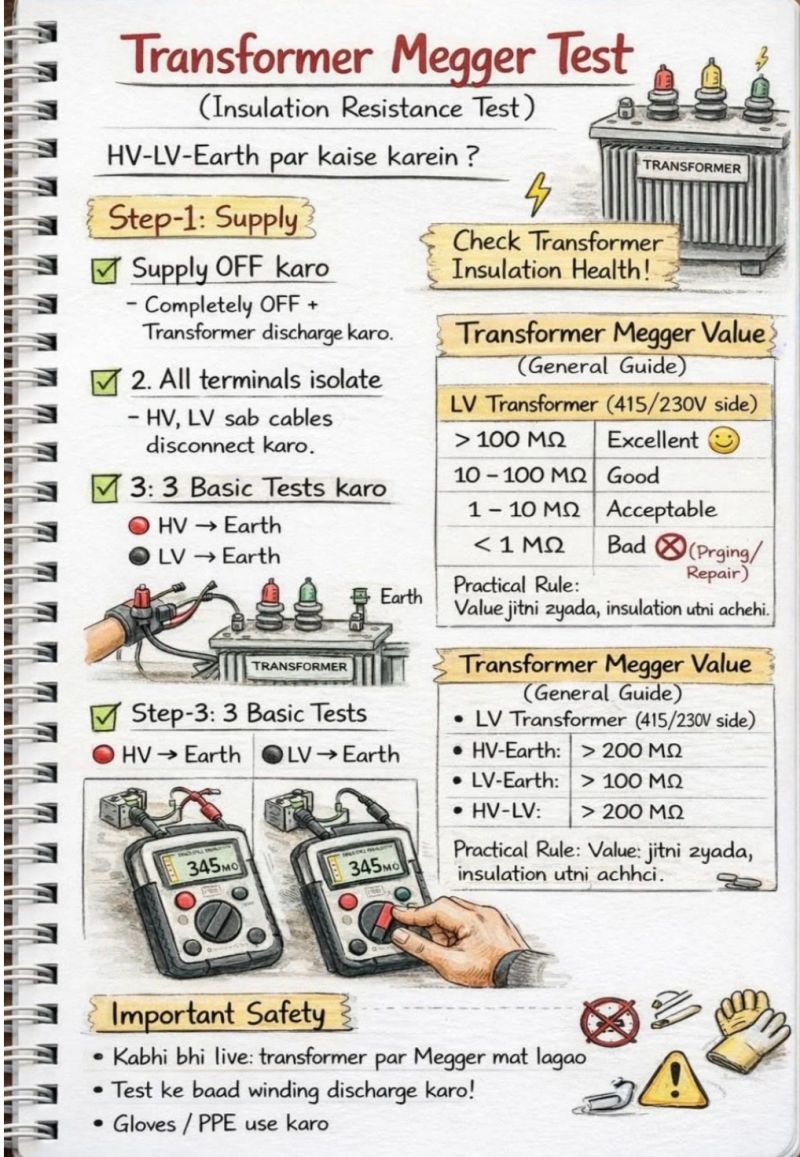
⚡ Step 1: Power OFF & Isolation
✔️ Switch OFF the transformer completely
✔️ Discharge the transformer properly
✔️ Disconnect all HV and LV cables
✔️ Ensure all terminals are fully isolated
⚡ Step 2: Perform 3 Basic Megger Tests
1️⃣ HV → Earth
2️⃣ LV → Earth
3️⃣ HV → LV
Set the megger to the appropriate test voltage (commonly 500V or 1000V depending on transformer rating).
Transformer Megger Value – General Guide
LV Transformer (415V / 230V Side)
> 100 MΩ → Excellent Condition ✅
10 – 100 MΩ → Good
1 – 10 MΩ → Acceptable ⚠️
< 1 MΩ → Poor ❌ (Drying or Repair Required)
Recommended Practical Values:
HV – Earth: > 200 MΩ
LV – Earth: > 100 MΩ
HV – LV: > 200 MΩ
Practical Rule:
The higher the insulation resistance value, the healthier the insulation.
Important Safety Precautions
⚠️ Never perform a megger test on a live transformer
⚠️ Always discharge windings after testing
⚠️ Use proper PPE (gloves, safety shoes, etc.)
⚠️ Ensure proper grounding before and after testing
Routine insulation resistance testing improves transformer reliability, safety, and operational life.
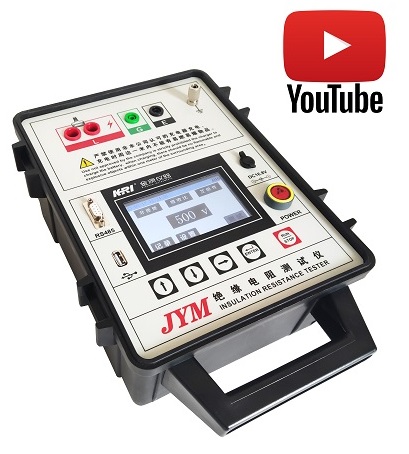
JYM insulation resistance tester

Kingrun Transformer Instrument Co.,Ltd.



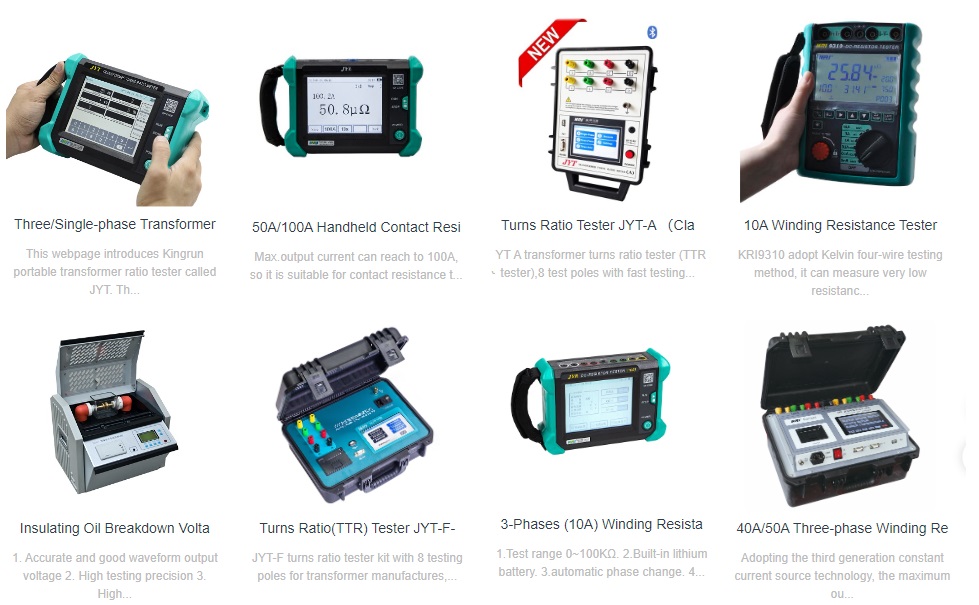
More Transformer Testers from Kingrun