Testing is the cornerstone of ensuring transformer reliability and a key bridge connecting transformer theoretical design and operational safety. For new transformers, rigorous factory testing ensures that the equipment meets the nameplate specifications and can withstand the test of long-term operation. For refurbished or remanufactured, the focus of testing shifts to diagnostic verification — confirming that the iron core and windings are intact, and that the refurbishment process has successfully restored the equipment's integrity to near-original standards.
Naturally, testing must comply with strict standards. Currently, IEEE C57.12.00 and IEEE C57.12.90 are the main standards for liquid-immersed distribution transformers, power transformers, and voltage-regulating transformers. IEEE C57.12.01 and IEEE C57.12.91, on the other hand, regulate dry-type distribution transformers and power transformers. These standards define "routine tests" (required for each piece of equipment), "design tests" (used to verify model design), and "other tests" (customer-specific tests). Understanding these classifications is crucial for engineers to ensure that the selected transformer — whether new or refurbished — can withstand the expected load without premature failure.
Standard Test Checklist for New and Refurbished Transformers:
Test Items
Remanufactured
(All Types)
New 600V
Dry
New MV
Dry
New Dist.
Liquid
New Class I
Power Sub
Turns Ratio (TTR)
Required
Required
Required
Required
Required
Winding Resistance
Required
≥ 300 kVA
≥ 300 kVA
> 2500 kVA
Required
Impedance & Load Loss
Required
Required
Required
Required
Required
Polarity & Phase Relation
Required
Required
Required
Required
Required
No-Load Loss & Excitation
Required
Required
Required
Required
Required
Applied Voltage (Hipot)
Optional
Required
Required
Required
Required
Induced Voltage
Optional
Required
Required
Required
Required
Insulation Res. (Megger)
Required
≥ 300 kVA
≥ 300 kVA
Required
Required
Insulation Power Factor
Optional
Optional
Optional
Optional
Required
Lightning Impulse
Optional
Design Test
Design Test
Design Test
Required
Pressure & Leak Test
Required
N/A
N/A
Required
Required
Oil Analysis (DGA)
Optional
N/A
N/A
Optional
Required
1. Turns Ratio Test (TTR)
Measures the voltage ratio between transformer windings to verify compliance with nameplate values and design specifications.
Significance: Validates correct winding turns, detects inter-turn short circuits or tap switch faults, and is mandatory for factory acceptance and post-overhaul checks.
Standard Range:
- Power transformers: Ratio deviation typically ≤ ±0.5% (IEC 60076);
- Distribution transformers: Generally ≤ ±1%.
2. Winding Resistance
Measures the DC resistance of each phase winding to reflect conductor material, cross-sectional area, and joint contact conditions.
Significance: Detects broken strands, loose connections, or inter-turn short circuits in windings.
Standard Range:
- Three-phase unbalance: ≤2% for distribution transformers, ≤1% for power transformers;
- Deviation from factory values: Generally ≤ ±2%.
3. Impedance Voltage and Load Loss
Impedance voltage is the voltage applied to the primary winding when the secondary is shorted to achieve rated current; load loss is the active power loss under this condition.
Significance: Evaluates load capacity, efficiency, and short-circuit withstand capability, and is a key indicator for energy efficiency classification.
Standard Range:
- 10kV distribution transformers: Load loss meets IEC60076 energy efficiency requirements;
- Large power transformers: Impedance voltage deviation typically ≤ ±10%.
4. No-Load and Phase Relationship
No-load loss is the active power loss when the secondary is open; no-load current is the excitation current under this condition; phase relationship verifies winding polarity and connection group designation.
Significance: Assesses core quality, detects local overheating, and ensures phase consistency for parallel operation.
Standard Range:
- No-load current: ≤2% of rated current for distribution transformers;
- Connection group designation must match the nameplate.
5. No-Load Loss and Excitation Current
No-load loss refers to hysteresis and eddy current losses in the core under alternating magnetic fields; excitation current is the current required to maintain core magnetization.
Significance: Reflects core material performance and manufacturing quality, and is a core indicator for energy efficiency assessment.
Standard Range:
- Energy efficiency Level 1 distribution transformers: No-load loss reduced by ~30% compared to standard models;
- Excitation current: Generally 1%–3% of rated current.
6. Applied Voltage Test
Applies a specified power frequency AC voltage between windings and ground for a defined duration.
Significance: Verifies the ability of main insulation to withstand power frequency overvoltages and validates insulation strength.
Standard Range:
- 10kV transformers: Applied voltage 35kV/1min (IEC60071);
- 35kV transformers: Applied voltage 80kV/1min(IEC60071).
7. Induced Voltage Test
Applies a voltage higher than the rated value across windings by increasing the power frequency to assess longitudinal insulation (inter-turn, layer-to-layer) strength.
Significance: Detects inter-turn insulation defects to prevent short circuits during operation.
Standard Range:
- Induced voltage: Typically 2× rated voltage;
- Duration: Adjusted by frequency, generally ≤60s.
8. Impulse Voltage Test
Simulates lightning overvoltages by applying standard waveform impulse voltages (e.g., 1.2/50μs) to the transformer.
Significance: Validates the ability of winding insulation to withstand lightning overvoltages, a critical test for high-voltage transformers.
Standard Range:
- 110kV transformers: Full-wave impulse voltage 480kV(IEC60071);
- 220kV transformers: Full-wave impulse voltage 950kV (IEC60071).
9. Insulation Resistance (Megger)
Measures insulation resistance between windings-to-ground and phase-to-phase using a megohmmeter to reflect moisture, contamination, or degradation of insulation materials.
Significance: Quickly assesses overall insulation health and is the primary test in preventive maintenance.
Standard Range:
- Transformers ≤35kV: Insulation resistance ≥300MΩ (20℃);
- Absorption ratio R60/R15 ≥1.3, polarization index ≥1.5.
10. Insulation Power Factor
Measures the dielectric loss tangent (tanδ) of insulation to reflect aging, moisture, or local defects in dielectric materials.
Significance: Evaluates overall dielectric performance and is more sensitive than insulation resistance to early-stage degradation.
Standard Range:
- New transformers: tanδ ≤0.5% (20℃);
- In-service transformers: tanδ ≤1.0%, with no significant increase from historical values.
11. Temp Rise Test
Measures temperatures of windings, core, and oil under rated load to calculate the temperature rise above ambient conditions.
Kingrun Transformer Instrument Co.,Ltd.


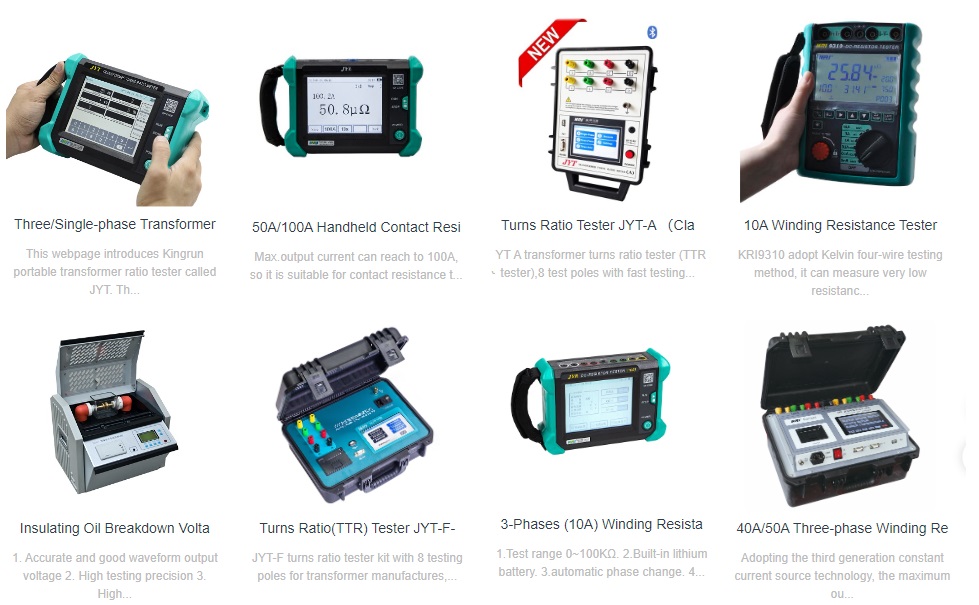
More Transformer Testers from Kingrun