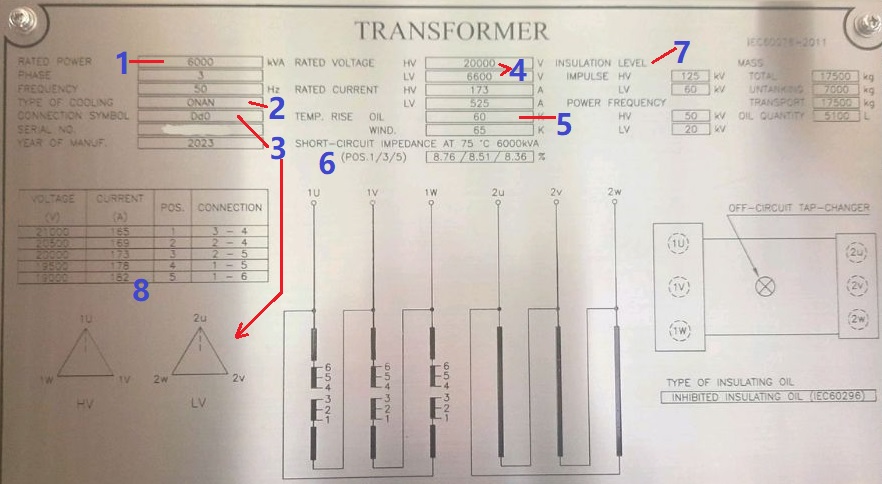
How to understanding the 6000 kVA Transformer Nameplate
Have you ever noticed the nameplate on a transformer and wondered what all the numbers mean? On a 6000 kVA transformer, this small metal plate works like an ID card, telling us about its capacity, cooling method, voltage levels, and safety limits. At first, these details may look complicated, but each one explains how the transformer is designed to handle large amounts of power reliably. Learning to read them turns a simple plate of data into a fascinating story of technology and engineering.
1️⃣ Rated Power: 6000 kVA, 3 Phase, 50 Hz
✔️ The maximum capacity of the transformer. This means that this transformer can transmit 6 MVA of electrical power.
✔️ 3 Phase, 50 Hz: This transformer operates on a 3-phase system with a standard frequency of 50 Hz, in accordance with the Indonesian electricity system.
2️⃣ ONAN
✔️ ONAN stands for Oil, Natural, Air, Natural. This transformer is cooled using naturally circulating insulating oil, which then releases the heat to the air through a radiator. So there are no additional pumps or fans.
3️⃣ Dd0 (Vector Group)
✔️ "This is the winding connection. Dd0 means delta-delta, and the phase shift is 0°. This means the HV and LV windings are both delta, and there is no phase shift. This is important for system synchronization, especially when paralleling transformers."
4️⃣ HV: 20,000 V, LV: 6,600 V
✔️ The nominal primary voltage is 20 kV. This means the transformer receives its supply from the 20 kV medium-sized distribution network.
✔️ The secondary voltage is 6.6 kV, which will be used to power large motors or the medium-sized distribution network.
5️⃣ Oil Temp. 60 K & Winding Temp. 65 K
✔️ This is the temperature rise at full load.
✔️ Oil Temp. 60 K means the oil temperature can rise 60°C above the standard ambient temperature (usually 40°C).
✔️ Winding Temp. 65 K means the windings can be 65°C hotter than the ambient temperature.
6️⃣ Short-Circuit Impedance (Z%)
✔️ Transformer impedance is expressed as a percentage (%).
✔️ The amount of voltage drop when the transformer carries the nominal short-circuit current (full load current).
7️⃣ Impulse & Power Frequency
HV Impulse 125 kV, LV Impulse 60 kV
✔️ HV 20 kV withstands impulses up to 125 kV
✔️ LV 6.6 kV withstands impulses up to 60 kV
Power Frequency HV 50 kV, LV 20 kV
✔️ AC voltage withstand test for 1 minute.
✔️ Factory testing (FAT) is performed. The HV side is tested at 50 kV AC for 1 minute, and the LV side at 20 kV AC for 1 minute, testing the insulation strength against a sinusoidal voltage without impulses.
8️⃣ Off-Load Tap Changer (OLTC)
✔️ Tap position is the setting of the number of turns on the high voltage (HV) side. With By changing the tap, we can increase or decrease the secondary voltage to suit the system's needs.
✔️ The transformer must be turned off before changing the tap.
✔️ Used in distribution transformers.
By exploring the nameplate of a 6000 kVA transformer, we unlock the key to understanding its true identity. Each specification—whether it is rated power, impedance, or insulation strength—reflects the balance of safety, efficiency, and durability. For engineers, it provides essential operating guidance, while for learners, it opens the door to the world of electrical power. Next time you see a transformer, you will know that its nameplate is not just a label, but the fingerprint of a powerful machine.
Vacuum Circuit Breaker Timer & Analyzer(JYK-II)

Kingrun Transformer Instrument Co.,Ltd.

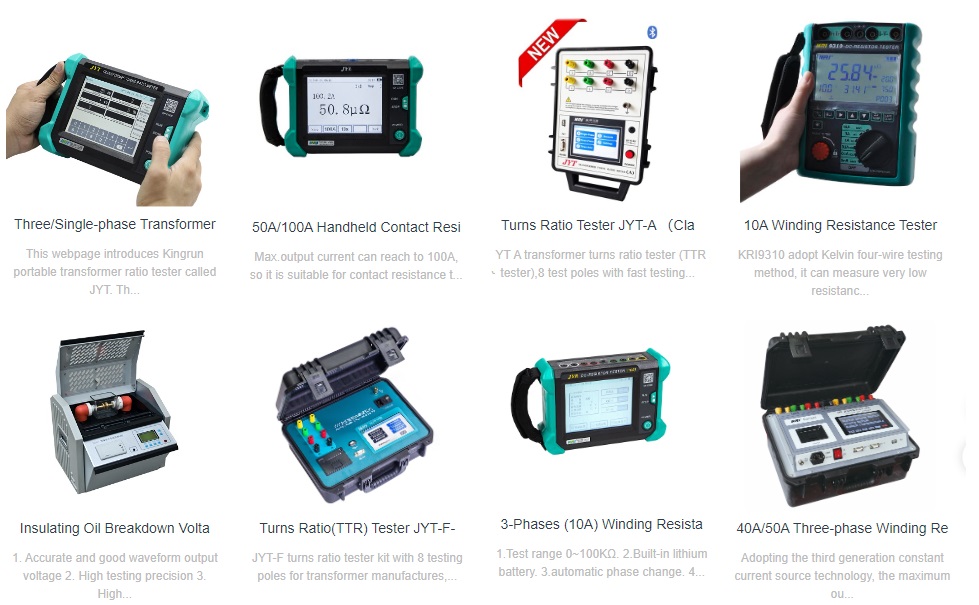
More Transformer Testers from Kingrun