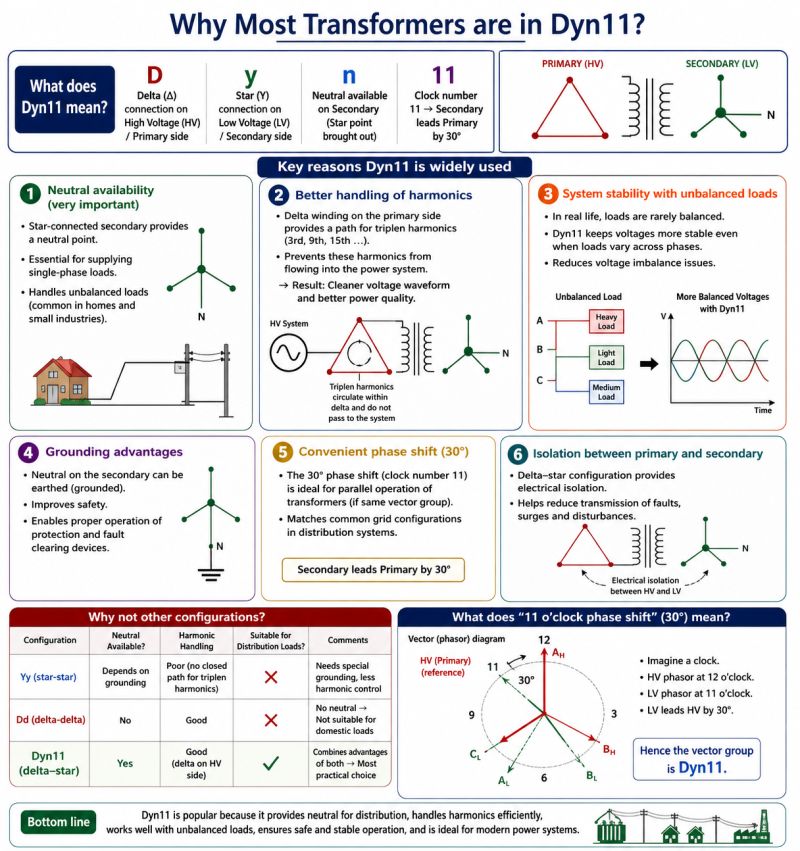
The designation Dyn11 represents a specific transformer vector group configuration. The capital letter "D" denotes a delta connection on the high-voltage (primary) side, while the lowercase "wye" symbol "y" signifies a star (wye) connection on the low-voltage (secondary) side. The suffix "n" indicates that the neutral point is brought out on the secondary side, and the number "11" utilizes the clock notation method to specify that the secondary line voltage leads the primary line voltage by 30 degrees in phase. This precise configuration perfectly aligns with phase-matching standards across major global distribution grids, serving as a fundamental prerequisite for the safe parallel operation of transformers.
The absolute dominance of Dyn11 in power distribution stems primarily from its exceptional capability to maintain power quality. The primary delta winding provides a closed-loop path that inherently traps triplen harmonics (such as the 3rd harmonic), preventing them from injecting into and polluting the upstream power grid, thereby ensuring a clean, smooth voltage waveform. Concurrently, the star-connected secondary with its accessible neutral line effortlessly handles the unbalanced loads typical of real-world consumption; it supplies both line-to-line and line-to-neutral voltages to accommodate mixed single-phase and three-phase loads, while stabilizing phase voltages during severe load imbalances.
In comparison, a Yy (star-star) configuration lacks the capacity to suppress harmonics, whereas a Dd (delta-delta) configuration cannot provide a neutral line to supply standard single-phase residential loads, making Dyn11 the most practical and optimized compromise. Furthermore, this delta-wye topology naturally offers superior zero-sequence isolation. When a single-phase-to-ground short circuit or similar fault occurs on the secondary side, the zero-sequence fault current is prevented from penetrating back into the primary-side grid, significantly enhancing overall system protection sensitivity and grounding safety.