The transformer DC winding resistance test is a core diagnostic and acceptance test in power equipment maintenance. Its principle is to apply a constant direct current to the transformer winding using a DC resistance tester, measure the voltage drop across the winding, and calculate the resistance value according to Ohm’s Law.
This parameter directly reflects the purity of the conductor material, consistency of cross-sectional area, and reliability of joints and connections. It is an essential indicator for detecting potential issues such as inter-turn short circuits, poor contacts, or open circuits. Therefore, it plays an irreplaceable role in ensuring the safe and stable operation of transformers and preventing minor defects from developing into major failures.
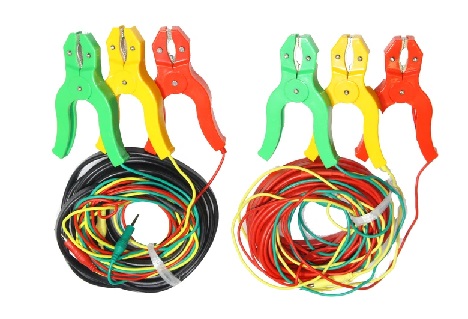
Test leads, especially current leads, possess inherent DC resistance.
When this lead resistance is comparable to the winding resistance, it will cause the measured value to be higher than the true resistance.
Small-capacity transformers have very low winding resistance (tens of milliohms).
Even a few meters of test lead may introduce over 10% error, while for large-capacity transformers (several ohms), the same lead resistance contributes less than 1% error.
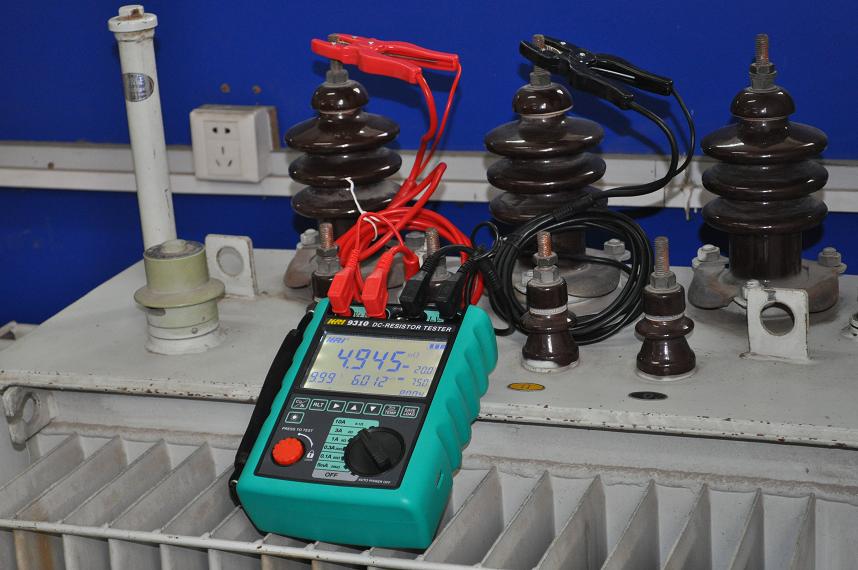
Modern resistance testers usually adopt the four-wire (Kelvin) measurement method,
where current and potential leads are separated. In this configuration, the lead length primarily affects the current loop, while the influence on the voltage measurement loop can be neglected.
Long test leads are more susceptible to electromagnetic interference.
External electromagnetic fields can induce small currents in the leads, distorting the measurement signal and reducing accuracy.
|
Transformer Type |
Recommended Lead Length (per side) |
Notes |
|
Small distribution transformers (≤ 630 kVA) |
≤ 3–5 m |
Keep the tester close to the transformer to minimize lead resistance. |
|
Medium transformers (800–3150 kVA) |
≤ 8–10 m |
Use leads with a cross-section of ≥ 4 mm². |
|
Large power transformers (≥ 4000 kVA) |
≤ 10–15 m |
Use 6~10 mm² thick copper leads; if necessary, extend current leads but keep potential leads short. |
Short-lead principle:
Place the tester as close to the transformer as possible. Test leads should generally not exceed 10 meters.
Four-wire method for low-voltage windings:
Since low-voltage windings have the smallest resistance, they are most sensitive to lead resistance.
For large-capacity transformers:
The lead length may be increased appropriately, but the conductor cross-section must be enlarged accordingly to prevent excessive voltage drop or lead heating, which may cause unstable readings.
Regular calibration:
Before each test, short-circuit the output terminals to measure the system’s zero resistance. This confirms that the lead resistance remains within the acceptable range.
Other Related Articles:
The Most Complete Transformer Vector Group Collection with Winding Connection Diagrams
How Important is Transformer DC Winding Resistance?
Top 6 transformer winding resistance testers Worldwide (Including Prices)
How should Winding Resistance be Tested Differently on CT and PT?
What is the Difference between DC Resistance and Insulation Resistance and How to Test Them?
8 Tips to Improve the Accuracy of DC Resistance Measurement
Why is the Tested Winding Resistance Always Inaccurate? You May Have Overlooked These 6 Key Points
More Transformer Testers from Kingrun

Kingrun Transformer Instrument Co.,Ltd.